Loading your experience...
Preparing something amazing for you
AI is rewriting how work gets valued, and almost nobody can tell you honestly where they stand with it. AI CRED measures your real fluency, then turns the result into a learning path that actually moves it.
A hard conversational assessment measures how you actually direct, verify, and build systems with AI. Then your learning plan turns that result into growth you can measure, instead of guesswork.
AI CRED Teams identifies real operators, shows you where the gaps are, and gives every member a path to level up. Capability you can build on, not just a grade.
Most people do not need another AI course. They need a few minutes of honesty about their own work. Spark asks what you actually do all day, what eats your time, and what you love enough to protect. Then it writes you a personal report: where AI hands you hours back, openings you had not thought to look for, and a straight answer about what it will not do.
It is free because it is the right first step. No credit card. Two reports with your account, yours to keep.
When the report shows you what is possible, the assessment shows you where you stand. That part is up to you.

Our users are extraordinary. These are real people in the real world gaining a measurable edge with AI fluency. No stock photos, no made-up quotes. Click through to visit their actual profiles.
Most people have no honest read on their AI fluency. They have done some courses. They use the tools. They feel capable. Feeling capable and being capable are not the same thing, and in a field this noisy, the gap between them is where careers quietly stall.
So AI CRED gives you an actual assessment. A six-section conversational assessment that gathers signal on how you direct AI, how deeply you understand the models, how you apply them in real work, how you verify what comes back, and whether you can build systems that outlast a single chat.
The result is a score you can trust, built from a rubric that measures five competency dimensions: AI Delegation & Direction, Technical & Model Literacy, Verification & Judgment, Practical Implementation, and Workflow, Skills, Agents & Harnesses. The 2026 rubric puts the heaviest weight on Workflow, Skills, Agents & Harnesses, because the field moved: fluency now means building reusable workflows, skills, agents, and harnesses, not phrasing one clever prompt.
The score is deliberately hard. Most people land in the middle. That is not a verdict. It is a starting point, because the score was never the product.
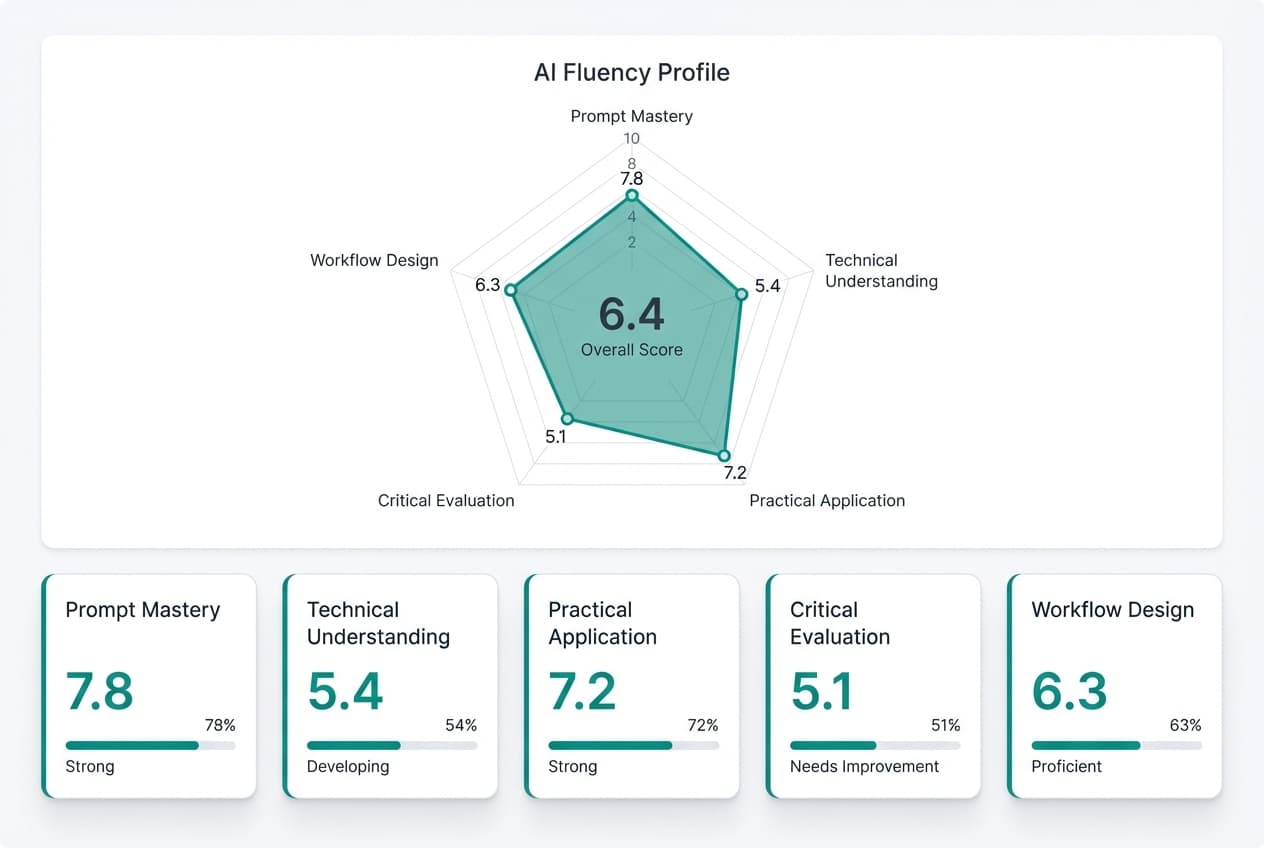
The learning plan is the product. It is built from what your assessment actually found, targets your specific gaps instead of a generic curriculum, and it is free once you are scored. Each module builds on the one before it, so the work compounds instead of starting over. When you level up, your official score moves up or holds. It never drops on a level-up, because improvement is the win condition here, not the number you started with.

That is the whole idea: measure honestly so you can grow deliberately. AI is one of the few forces that can genuinely level the playing field, but only for people who are actually fluent in it. The score tells you where you stand. The path changes where you stand.
The leaderboard proves it. I expected young tech natives to dominate. Instead? A 50-year workforce veteran architecting legislative document analysis. A 40-year Microsoft/Google engineer treating AI agents as a "managed fleet." A history teacher catching hallucinations before they reach students. Security professionals who assume AI is lying and build verification systems to prove it. The people winning aren't prompt engineers. They're professionals who were already great at their jobs.
View full leaderboardIf you are rolling AI out across a business, the team version shows you who can actually lead, who thinks they can but will create problems, and who is too hesitant to start. You find out before rollout, not after something breaks.